
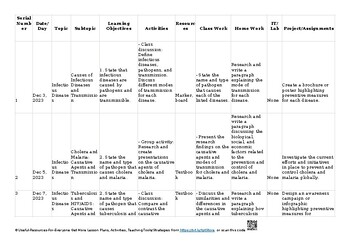
10 Infectious diseases – Biology 9700 AS & A Level Biology 9700 Lesson Plans / Unit Plans / Thematic Plans
Infectious diseases remain one of the greatest challenges to human health worldwide. From cholera and malaria to tuberculosis and HIV/AIDS, understanding the pathogens that cause these diseases, their modes of transmission, and the strategies for their prevention and control is essential for success in the Cambridge AS & A Level Biology 9700 syllabus. Welcome to the 10 Infectious diseases – Biology 9700 AS & A Level Biology 9700 Lesson Plans / Unit Plans / Thematic Plans – the Ultra Premium, Ultra Luxury teaching resource that will transform how you teach this vital topic. This isn’t just a collection of materials; it’s a powerful, cohesive thematic unit mastery experience crafted to build deep understanding of pathogens, disease transmission, and the global fight against infectious diseases.
Topic 10 Infectious Diseases is a core component of the Cambridge International AS & A Level Biology 9700 syllabus (2025-2027). This comprehensive unit covers 10.1 Infectious diseases and 10.2 Antibiotics, with a focus on the biology of the pathogen and its mode of transmission, which is essential if the disease is to be controlled and ultimately prevented. This resource is fully aligned with the Cambridge International 9700 specification (2025-2027) and is part of the Complete CIE AS & A Level Biology (9700) Quality Bundle covering all topics 1–18 and A2 topics 19–30.
Why This Infectious Diseases Bundle Is the Ultimate Biology Teaching Resource
There are countless biology resources on the internet, but what makes this infectious diseases lesson plans bundle outstanding is its comprehensive coverage, Ultra Premium quality, and alignment with the latest Cambridge AS & A Level Biology 9700 syllabus (2025-2027) – features not found in any ordinary resource. Whether you’re a classroom teacher, homeschool educator, or tutor, this infectious diseases unit plan will save you hours of planning and deliver measurable results in your students’ understanding of biology. This resource is fully aligned with the Cambridge International 9700 specification (2025-2027).
This resource directly addresses the specification points and provides bold definitions aligned with Cambridge textbook and exam phrasing. The Cambridge International AS & A Level Biology syllabus develops learners’ ability to apply a scientific approach to the study of topics such as infectious diseases, immunity, and antibiotics. Designed for new and experienced teachers with everything you need, this unit follows a structured, lesson-based format with consistent pedagogy to support both new and experienced A Level teachers. This resource covers both the AS and A Level content for Topic 10 Infectious Diseases, making it the perfect all-in-one solution for teachers of this qualification.
What Is Covered in Topic 10 Infectious Diseases?
Topic 10 Infectious Diseases is a core component of the Cambridge International AS & A Level Biology 9700 syllabus. The syllabus specifies that learners must understand the following key areas: 10.1 Infectious diseases and 10.2 Antibiotics.
The infectious diseases studied in this topic are caused by pathogens that are transmitted from one human host to another. Some, like Plasmodium that causes malaria, are transmitted by vectors, but there are many other methods of transmission, such as through water and food or during sexual activity. An understanding of the biology of the pathogen and its mode of transmission is essential if the disease is to be controlled and ultimately prevented. This comprehensive thematic unit plan covers all essential concepts including:
10.1 Infectious Diseases
- Pathogens and Infectious Disease – Understanding that infectious diseases are caused by pathogens (microorganisms that cause disease) and are transmissible between hosts. A pathogen is a microorganism that causes a disease in its host. The four main groups of pathogens are: bacteria (e.g., Vibrio cholerae for cholera, Mycobacterium tuberculosis for TB), viruses (e.g., HIV, measles virus), protoctists (e.g., Plasmodium species for malaria), and fungi (e.g., Trichophyton for athlete’s foot). An infectious disease is one that is caused by a pathogen and can be transmitted from one host to another, either directly (sexual contact, droplets in coughs) or indirectly (water, food, or via a vector such as a mosquito).
- Named Pathogens and Their Diseases – Stating the name and type of pathogen that causes each of the following diseases:
- Cholera – caused by the bacterium Vibrio cholerae
- Malaria – caused by the protoctists Plasmodium falciparum, Plasmodium malariae, Plasmodium ovale and Plasmodium vivax
- Tuberculosis (TB) – caused by the bacteria Mycobacterium tuberculosis and Mycobacterium bovis
- HIV/AIDS – caused by the human immunodeficiency virus (HIV)
- Transmission of Diseases – Explaining how cholera, malaria, TB and HIV are transmitted:
- Cholera – transmitted through ingestion of water or food contaminated with faeces containing V. cholerae. Transmission becomes more likely where sewage contaminates drinking-water supplies, sanitation is limited or hygienic food handling is difficult.
- Malaria – transmitted by a vector. An infected female Anopheles mosquito can transmit Plasmodium when feeding on human blood.
- Tuberculosis (TB) – transmitted mainly in airborne droplets or aerosols released by an infected person, especially during prolonged close contact in poorly ventilated spaces. M. bovis can also infect humans, historically through unpasteurised milk from infected cattle.
- HIV/AIDS – transmitted through sexual contact, blood-to-blood contact, and from mother to child.
- Prevention and Control of Diseases – Discussing the biological, social and economic factors that need to be considered in the prevention and control of cholera, malaria, TB and HIV:
- Cholera control – Safe water treatment, protected water sources, sewage treatment, latrines, handwashing and hygienic food preparation reduce the chance that bacteria move from faeces to a new host. Rapid diagnosis and treatment reduce harm, while surveillance can identify outbreaks and target resources.
- Malaria control – Insecticide-treated bed nets reduce contact between mosquitoes and sleeping people. Indoor residual spraying can kill mosquitoes resting on treated surfaces. Removing or managing standing water can reduce breeding sites. Prompt diagnosis, antimalarial treatment and preventative medicines can reduce illness and the reservoir of transmissible infection.
- TB control – Early case detection, contact tracing, appropriate multidrug treatment, good ventilation, reduction of crowded exposure, vaccination where programmes use it, cattle testing and milk pasteurisation. Completing the prescribed multidrug course is important because MDR-TB (multi-drug resistant tuberculosis) is a global concern.
- HIV/AIDS control – Safe sex practices, screening of blood products, use of sterile needles, antiretroviral therapy (ART) to manage the condition, and education to reduce transmission. HIV targets T helper (CD4+) cells, leading to immune collapse and opportunistic infections.
- Biological, social and economic factors – Biological feasibility is not enough. Infrastructure costs, rapid urban growth, conflict, public trust, access to care and the ability to maintain water systems affect whether a measure succeeds. Control is challenged by insecticide resistance, drug resistance, mosquito behaviour, climate, migration, housing quality, healthcare access and sustained cost.
- Global Patterns of Distribution – Discussing the factors that influence the global pattern of distribution of named infectious diseases. Terms describing spread: Endemic (constantly present in a population), Epidemic (sudden increase above expected baseline), Pandemic (epidemic that has spread across many countries). Cholera is endemic in many developing countries; malaria is endemic in sub-Saharan Africa; TB is a global concern with higher incidence in developing countries; HIV/AIDS has a global distribution with highest prevalence in sub-Saharan Africa.
- Smallpox and Measles – Cambridge expects you to know five named diseases in detail — cholera, malaria, TB, HIV/AIDS and either smallpox or measles. Smallpox is a viral disease that was declared eradicated by the WHO in 1980 (the only human disease to have been eradicated). Measles is a viral disease, prevented by the MMR vaccine, which requires approximately 95% herd immunity for effective control.
10.2 Antibiotics
- Penicillin Action – Outlining how penicillin acts on bacteria and why antibiotics do not affect viruses. Penicillin acts on bacteria by interfering with the synthesis of the bacterial cell wall. Antibiotics do not affect viruses because viruses do not have a cell wall and replicate inside host cells using the host’s cellular machinery.
- Antibiotic Resistance – Discussing the consequences of antibiotic resistance and the steps that can be taken to reduce its impact. The misuse of antibiotics leads to the development of antibiotic resistance in bacterial populations through natural selection – bacteria with resistance mutations survive and reproduce, passing on the resistance genes. Consequences include treatment failure, increased morbidity and mortality, and the emergence of MDR-TB and other drug-resistant pathogens. Strategies to slow its spread include: completing prescribed antibiotic courses, avoiding the use of antibiotics for viral infections, using narrow-spectrum antibiotics where possible, and developing new antibiotics.
What’s Included in This Comprehensive Infectious Diseases Thematic Unit
1. Complete PowerPoint Unit
This infectious diseases lesson plans bundle includes a comprehensive, ready-to-use PowerPoint presentation covering the entire Topic 10 syllabus. The PowerPoint includes:
- Starter slides with lesson number, title and learning goals
- Retrieval starters or warm-up questions at the beginning of each lesson
- Chunked explanations for complex biological concepts
- Click-in animations for modelling, annotation, and gradual reveal of diagrams and processes
- Bold, exam-aligned definitions that match Cambridge textbook and mark scheme language
- High-quality diagrams of disease transmission routes, pathogen structures, and global distribution maps
- Real-world examples of disease outbreaks and control measures
- Summary tables for pathogens, transmission routes, and control measures
- Independent practice tasks matched to Cambridge exam phrasing
- Exam-style questions for Papers 1, 2, 3 and 4 practice
- Plenaries linked to initial learning objectives
- End-of-unit assessment questions in full exam style
- Fully aligned with Cambridge International 9700 specification
Lessons include:
- Lesson 1: Introduction to Infectious Diseases – Pathogens and Transmission
- Lesson 2: Cholera – Pathogen, Transmission and Control
- Lesson 3: Malaria – Pathogen, Transmission and Control
- Lesson 4: Tuberculosis (TB) – Pathogen, Transmission and Control
- Lesson 5: HIV/AIDS – Pathogen, Transmission and Control
- Lesson 6: Smallpox and Measles – Viral Diseases and Eradication
- Lesson 7: Global Patterns of Infectious Diseases – Endemic, Epidemic and Pandemic
- Lesson 8: Biological, Social and Economic Factors in Disease Control
- Lesson 9: Antibiotics – Penicillin Mode of Action
- Lesson 10: Antibiotic Resistance – Causes, Consequences and Solutions
- Lesson 11: Infectious Diseases Review and Assessment
2. Editable Lesson Plans
This infectious diseases thematic unit includes detailed lesson plans covering the entire Topic 10 syllabus. Each lesson plan includes:
- Learning objectives – Clear, measurable outcomes aligned with the Cambridge 9700 syllabus
- Key vocabulary – Essential biology terms and definitions for each lesson
- Teaching methodology – Step-by-step guidance for effective instruction
- Differentiation strategies – Support for all learners
- Assessment opportunities – Formative and summative assessment ideas
- Resources needed – Materials and equipment required for each lesson
- Practical activities – Suggestions for hands-on investigations
3. Differentiated Worksheets
Assess understanding with a variety of well-formatted, editable worksheets:
- Infectious Diseases Vocabulary – Key terms and definitions
- Pathogen Classification – Identifying and classifying pathogens
- Disease Transmission Routes – Understanding how diseases spread
- Cholera – Pathogen and Control – Understanding Vibrio cholerae and prevention
- Malaria – Pathogen and Control – Understanding Plasmodium and prevention
- Tuberculosis – Pathogen and Control – Understanding Mycobacterium and prevention
- HIV/AIDS – Pathogen and Control – Understanding HIV and prevention
- Smallpox and Measles Comparison – Comparing viral diseases
- Global Patterns of Disease – Analysing disease distribution
- Biological, Social and Economic Factors – Evaluating disease control
- Penicillin and Antibiotic Action – Understanding antibiotic mechanisms
- Antibiotic Resistance – Causes and solutions
- Past Paper Questions – Exam-style practice questions with mark schemes
- Cut and Paste Activities – Hands-on sorting and labelling
4. Assessment Tools
Track student progress with comprehensive assessment tools:
- End-of-Topic Assessment – Full exam-style questions for Papers 1, 2, 3 and 4
- Short Answer Questions – Define and describe biological concepts
- Diagram Labelling Questions – Apply knowledge to diagrams
- Essay Questions – Evaluate disease control strategies
- AfL Checks – Assessment for learning activities embedded throughout
- Progress Monitoring Tools – Track student mastery
- Exit Tickets – Quick comprehension checks
- Assessment Rubric – For assessment and feedback
- Skill Recording Chart – Track student progress
5. Bonus Materials
Enhance your instruction with additional resources:
- Infectious Diseases Poster Set – Beautiful classroom displays
- Pathogen Reference Sheets – Quick reference guides
- Disease Control Strategies Comparison Table – Visual reference
- Global Disease Distribution Maps – Real-world data
- Interactive Notebook Pages – Digital and printable options
- Differentiation Guidance – Support for all learners
- Teaching Notes – Tips and strategies for each lesson
- Curriculum Mapping – Alignment with the latest Cambridge 9700 syllabus
- Scheme of Work – Suggested 4-5 week unit plan
50+ Reasons Why This Infectious Diseases Bundle Is the Best Biology Resource
- ✅ Complete Topic 10 Coverage – Everything for Infectious Diseases of Cambridge 9700
- ✅ Latest Syllabus Aligned – Matches the 2025-2027 Cambridge syllabus
- ✅ Ready-to-Teach – Fully planned and sequenced thematic unit
- ✅ Engaging PowerPoint – Slides with animations and click-in diagrams
- ✅ 11+ Lessons – Full unit coverage for Topic 10
- ✅ Clear Explanations – Key terms and definitions in bold
- ✅ Exam-Focused – Exam-style questions for Papers 1, 2, 3 and 4
- ✅ Zero Prep Required – Ready to teach immediately
- ✅ Fully Editable – Adapt to your students’ needs
- ✅ Answer Keys Included – Save time on grading
- ✅ Pathogens – Bacteria, viruses, protoctists and fungi
- ✅ Cholera – Vibrio cholerae, water-borne, cholera toxin → diarrhoea + dehydration
- ✅ Malaria – Plasmodium species, vector = female Anopheles mosquito, affects liver + RBCs
- ✅ Tuberculosis (TB) – Mycobacterium tuberculosis and M. bovis, airborne droplets
- ✅ HIV/AIDS – Retrovirus targets T helper (CD4+) cells → immune collapse → opportunistic infections
- ✅ Smallpox – Viral, declared eradicated by WHO in 1980
- ✅ Measles – Viral, MMR vaccine, requires ~95% herd immunity
- ✅ Transmission – Direct and indirect routes, vectors
- ✅ Disease Control – Biological, social and economic factors
- ✅ Antibiotics – Penicillin action on bacterial cell walls
- ✅ Antibiotic Resistance – Mutation, selection, MDR-TB
- ✅ Global Patterns – Endemic, epidemic, pandemic
- ✅ Starter Slides – Learning goals at the beginning of each lesson
- ✅ Retrieval Starters – Warm-up questions
- ✅ Chunked Explanations – For complex biological concepts
- ✅ Click-in Animations – Modelling and gradual reveal
- ✅ AfL Checks – Embedded assessment for learning
- ✅ Independent Practice – Cambridge exam phrasing matched
- ✅ Plenaries – Linked to learning objectives
- ✅ End-of-Topic Assessment – Full exam style
- ✅ Exam-Aligned Definitions – Cambridge mark scheme language
- ✅ High-Quality Diagrams – Transmission routes and pathogen visuals
- ✅ Real-World Examples – Practical applications of biological concepts
- ✅ Global Disease Maps – Understanding disease distribution
- ✅ Exam-Focused – Designed for Cambridge exam success
- ✅ Grades 10-12 – Suitable for AS and A Level
- ✅ Adult Education – Suitable for higher education
- ✅ Biology – Build essential biological knowledge
- ✅ Critical Thinking – Develop analytical and evaluative skills
- ✅ Digital Ready – PowerPoint format with animations
- ✅ Printable Resources – Ready for in-class use
- ✅ Editable in Multiple Formats – PPT, PDF
- ✅ Differentiation Ready – Adapt for different learning levels
- ✅ Hands-On Activities – Engaging group work
- ✅ Independent Practice – Worksheets for individual work
- ✅ Exit Tickets – Quick comprehension checks
- ✅ Progress Monitoring – Track student mastery
- ✅ Assessment Rubric – For assessment and feedback
- ✅ Comprehensive Answer Keys – Complete solutions provided
- ✅ Time-Saving – Reduce planning time significantly
- ✅ Test Prep Ready – Prepare for Cambridge exams
- ✅ Engaging Visuals – Keep students interested
- ✅ Flexible Use – Whole class, small group, or individual
- ✅ Homework Ready – Easy to assign for practice
- ✅ Professional Quality – Ultra Premium materials
- ✅ Affordable Pricing – Exceptional value for money
- ✅ Lifetime Access – Use year after year
- ✅ Teacher-Approved – Designed by experienced educators
What Educators Are Saying
⭐⭐⭐⭐⭐ Sarah Mitchell – AS & A Level Biology Teacher, London, UK
“This infectious diseases bundle is absolutely incredible! My students finally understand the difference between the pathogens that cause cholera, malaria, TB and HIV/AIDS. The PowerPoint is engaging with beautiful click-in animations, and the exam-style questions are excellent. The new syllabus coverage (2025-2027) is comprehensive. Highly recommend for any Cambridge 9700 teacher!”
⭐⭐⭐⭐⭐ David Chen – A Level Biology Teacher, Singapore
“I’ve been teaching infectious diseases for years and this is the best resource I’ve ever used. The disease transmission and control sections are particularly outstanding. My students’ understanding of the biological, social and economic factors affecting disease control has improved dramatically. The differentiated approach is perfect for my diverse learners. A must-have for any Biology teacher!”
⭐⭐⭐⭐⭐ Emily Rodriguez – AS Level Biology Tutor, Dubai, UAE
“This infectious diseases teaching bundle saved my life! I had no idea how to teach antibiotic resistance effectively until I found this resource. The PowerPoint is visually stunning and the click-in animations keep my students engaged. The global patterns section is particularly useful. Worth every penny!”
⭐⭐⭐⭐⭐ Michael Thompson – Head of Biology, Melbourne, Australia
“As a department head, I needed a comprehensive infectious diseases curriculum for our AS and A Level students. This bundle exceeded my expectations. The lesson plans are easy to follow and the summary tables consolidating key pathogens and diseases are excellent. My students love the real-world case studies and exam-style practice!”
⭐⭐⭐⭐⭐ Jessica Park – Homeschooling Parent, New York, USA
“As a homeschooling parent, I needed resources that would help my daughter master infectious diseases for her Cambridge exams. This bundle exceeded my expectations. The lesson plans are easy to follow and the answer keys make grading simple. She aced her Topic 10 test!”
⭐⭐⭐⭐⭐ Robert Johnson – Biology Teacher, Toronto, Canada
“This infectious diseases bundle is Ultra Premium quality! The PowerPoint is beautiful with clear diagrams, the worksheets are thorough, and the exam-style Papers 1, 2, 3 and 4 questions provide excellent practice. My students’ understanding of cholera toxin and its effects has improved dramatically. The antibiotic resistance activities are outstanding!”
⭐⭐⭐⭐⭐ Amanda White – AS Level Biology Teacher, Auckland, New Zealand
“I was struggling to teach the transmission of malaria until I found this resource. The step-by-step approach to understanding the vector and the Plasmodium species is so clearly presented with worked examples. My students love the summary tables for pathogens and their diseases!”
⭐⭐⭐⭐⭐ James Brown – Biology Department Head, Boston, USA
“The HIV/AIDS section is outstanding! My students finally understand how HIV targets T helper cells and leads to immune collapse. The smallpox and measles comparison activities are also excellent. The global patterns section is highly relevant. Highly recommend this biology bundle!”
⭐⭐⭐⭐⭐ Lisa Martinez – ESL Biology Teacher, Madrid, Spain
“I use this infectious diseases bundle with my ESL students and it’s perfect. The clear explanations, visual aids, and vocabulary activities help my students understand biological concepts. The bold definitions aligned with Cambridge exam phrasing are particularly helpful. The retrieval starters are great for assessment.”
⭐⭐⭐⭐⭐ Daniel Kim – A Level Biology Teacher, Seoul, South Korea
“This is the most comprehensive infectious diseases resource I’ve ever purchased. The lesson plans cover pathogens, transmission, control, global patterns, antibiotics and antibiotic resistance. The worksheets provide excellent practice and the answer keys are a lifesaver!”
⭐⭐⭐⭐⭐ Rachel Green – Special Education Teacher, Portland, USA
“I love how adaptable this infectious diseases bundle is. I can easily differentiate for my students with special needs. The clear explanations and visual aids help all my students succeed. The chunked explanations and AfL checks are particularly effective for my learners.”
⭐⭐⭐⭐⭐ Kevin Patel – Tutoring Center Director, Mumbai, India
“We use this infectious diseases bundle for all our AS and A Level Biology tutoring. The comprehensive coverage, engaging activities, and exam-style practice make it perfect for our program. Our students’ understanding of Topic 10 has improved significantly!”
⭐⭐⭐⭐⭐ Nicole Adams – Biology Teacher, Sydney, Australia
“The infectious diseases lesson plans are so well-structured and the PowerPoint is visually stunning. My students actually look forward to biology lessons now! The exam-style questions provide excellent practice and help me track their progress. The starter slides are a permanent fixture in my classroom!”
⭐⭐⭐⭐⭐ Thomas Wilson – AS Level Teacher, Johannesburg, South Africa
“This infectious diseases bundle is worth every dollar. The lesson plans save me hours of planning time, the worked examples are excellent, and the exam-style questions make assessment a breeze. I can’t imagine teaching Topic 10 without this resource!”
⭐⭐⭐⭐⭐ Maria Garcia – Bilingual Biology Teacher, Buenos Aires, Argentina
“I use this infectious diseases bundle in my bilingual classroom and it’s perfect. The clear explanations and visual aids help my English language learners understand biological concepts easily. The worksheets provide excellent practice and the answer keys are a lifesaver. The disease control activities are used weekly in my classroom!”
⭐⭐⭐⭐⭐ Andrew Lee – A Level Teacher, Hong Kong
“This infectious diseases bundle is amazing! The interactive activities are so engaging, and the worked examples are clear and easy to understand. My students’ understanding of antibiotic resistance has improved so much since using this resource. The summary tables are on my wall permanently!”
⭐⭐⭐⭐⭐ Jennifer Taylor – Biology Coach, Dublin, Ireland
“I recommend this infectious diseases bundle to all the teachers I work with. The comprehensive coverage, engaging activities, and exam-focused materials make it the perfect biology resource. The PowerPoint is visually stunning and keeps students engaged. The differentiation guidance is invaluable for new teachers!”
⭐⭐⭐⭐⭐ Christopher Moore – Biology Teacher, Nairobi, Kenya
“The cholera control section is excellent! My students finally understand how sanitation and water treatment can prevent disease. The malaria control activities are also outstanding. Highly recommend this biology bundle!”
⭐⭐⭐⭐⭐ Stephanie Lewis – AS Level Teacher, Vancouver, Canada
“This infectious diseases bundle has transformed my biology instruction. The lesson plans are thorough and easy to follow, the PowerPoint is engaging, and the exam-style questions save me hours of preparation time. My students love the click-in animations and the exit tickets help me quickly assess understanding!”
⭐⭐⭐⭐⭐ William Clark – School Principal, London, UK
“We purchased this infectious diseases bundle for our entire Biology department. The teachers love the comprehensive lesson plans and the students are engaged by the vibrant PowerPoint with click-in animations. The exam-style Papers 1, 2, 3 and 4 questions provide excellent exam preparation. A fantastic investment in our students’ success!”
Don’t Wait – Transform Your Biology Instruction Today!
10 Infectious diseases – Biology 9700 AS & A Level Biology 9700 Lesson Plans / Unit Plans / Thematic Plans is the Ultra Premium, Ultra Luxury biology resource every Cambridge teacher needs. With comprehensive coverage of pathogens, disease transmission, prevention and control of cholera, malaria, tuberculosis and HIV/AIDS, and antibiotics and antibiotic resistance, this infectious diseases unit plan will save you hours of planning and deliver measurable results in your students’ understanding of biology.
This resource is fully aligned with the Cambridge International 9700 specification (2025-2027) and is part of the Complete CIE AS & A Level Biology (9700) Quality Bundle covering all topics 1–18 and A2 topics 19–30.
🎯 Order now and master Infectious Diseases with confidence!
Boost Mathematical Skills with The Buddy Wizkid Math Academy
Looking to enhance math skills in a fun, engaging way? Download and share The Buddy Wizkid Math Academy App with students, parents, and teachers to boost mathematical skills through play-based learning!
📱 DOWNLOAD THE BUDDY WIZKID MATH ACADEMY – FREE!
Upgrade to Cambridge Classroom Pro App
Transform your entire teaching experience with the Cambridge Classroom Pro App – the ultimate all-in-one teacher tool with timetables, attendance, grading, exam marking, Royal Canvas, and so much more!
🔥 GET CAMBRIDGE CLASSROOM PRO APP – JUST $100 (REGULAR $900) 🔥
10 Infectious diseases – Biology 9700 AS & A Level Biology 9700 Lesson Plans / Unit Plans / Thematic Plans – The ultimate Cambridge biology resource. Order today and transform your biology instruction!


Reviews
There are no reviews yet.