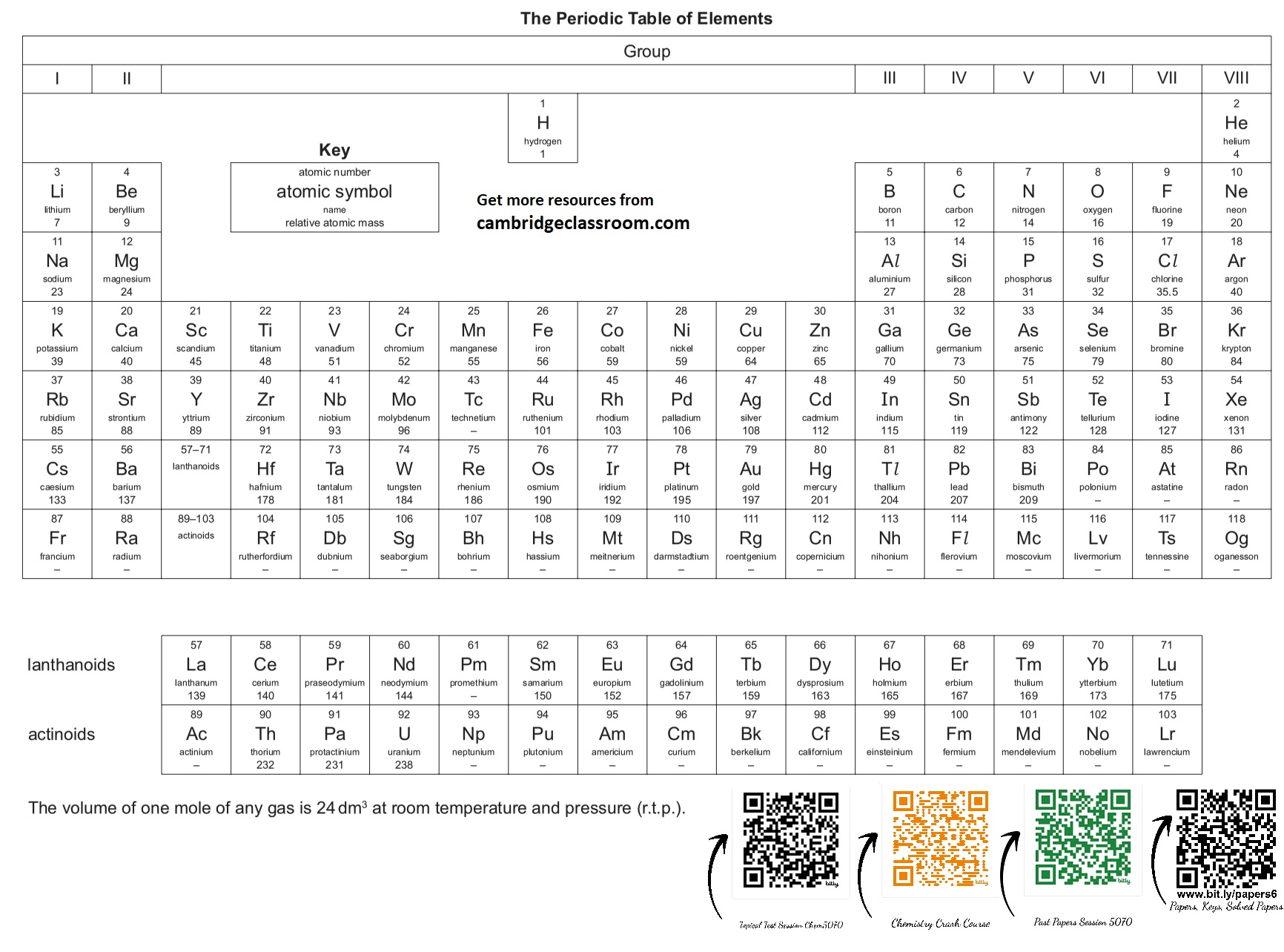
Cambridge Periodic Table: #1 O Level & IGCSE Chemistry Guide
Cambridge Periodic Table: Complete O Level & IGCSE Chemistry Guide Master the Periodic Table with Cambridge’s Official Syllabus – Get […]
Cambridge Periodic Table: #1 O Level & IGCSE Chemistry Guide Read More »


![Fundamental Concepts & States of Matter • Atom: The smallest particle of an element that can exist, made of a nucleus (protons and neutrons) and electrons orbiting it. • Element: A pure substance consisting of only one type of atom, which cannot be broken down into simpler substances by chemical means. • Compound: A substance formed when two or more different elements are chemically bonded together in a fixed ratio. • Mixture: A substance containing two or more elements or compounds not chemically bonded together. Can be separated by physical means. • Molecule: A group of two or more atoms held together by chemical bonds. • Proton: A subatomic particle found in the nucleus with a relative mass of 1 and a charge of +1. • Neutron: A subatomic particle found in the nucleus with a relative mass of 1 and no charge (0). • Electron: A subatomic particle orbiting the nucleus with a negligible relative mass and a charge of -1. • Atomic Number (Z): The number of protons in the nucleus of an atom. Defines the element. • Mass Number (A): The total number of protons and neutrons in the nucleus of an atom. • Isotopes: Atoms of the same element (same atomic number) but with different mass numbers due to a different number of neutrons. • Relative Atomic Mass ($A_r$): The weighted average mass of an atom of an element compared to $1/12$th the mass of a carbon-12 atom. • Relative Molecular Mass ($M_r$): The sum of the relative atomic masses of all atoms in one molecule of a compound. • Relative Formula Mass ($M_r$): The sum of the relative atomic masses of all atoms in the formula unit of an ionic compound. • Mole: The amount of substance that contains $6.02 \times 10^{23}$ particles (Avogadro's number). • Molar Mass: The mass of one mole of a substance, expressed in g/mol. Numerically equal to $A_r$ or $M_r$. • Empirical Formula: The simplest whole number ratio of atoms of each element in a compound. • Molecular Formula: The actual number of atoms of each element in a molecule. • Solid: Particles are closely packed in a fixed, regular arrangement, vibrate about fixed positions. Definite shape and volume. • Liquid: Particles are closely packed but randomly arranged, can slide past each other. Definite volume, no definite shape. • Gas: Particles are far apart and arranged randomly, move rapidly and randomly. No definite shape or volume. • Melting Point: The specific temperature at which a solid changes into a liquid at a given pressure. • Boiling Point: The specific temperature at which a liquid changes into a gas (vaporizes) at a given pressure. • Sublimation: The direct change of state from solid to gas without passing through the liquid phase (e.g., solid $\text{CO}_2$). • Diffusion: The net movement of particles from a region of higher concentration to a region of lower concentration, due to random motion. • Osmosis: The net movement of water molecules across a partially permeable membrane from a region of higher water potential to a region of lower water potential. 2. Structure & Bonding • Ionic Bond: The electrostatic force of attraction between oppositely charged ions, formed by the transfer of electrons from a metal to a non-metal. • Covalent Bond: A strong electrostatic force of attraction between a shared pair of electrons and the nuclei of the bonded atoms, typically between two non-metals. • Metallic Bond: The electrostatic force of attraction between positive metal ions and delocalised electrons. • Ion: An atom or group of atoms that has gained or lost electrons, resulting in a net electrical charge. • Cation: A positively charged ion (lost electrons). • Anion: A negatively charged ion (gained electrons). • Octet Rule: Atoms tend to gain, lose, or share electrons in order to achieve a full outer electron shell, typically with eight electrons. • Giant Ionic Lattice: A regular, repeating 3D arrangement of oppositely charged ions, held together by strong electrostatic forces. • Simple Molecular Structure: Molecules held together by strong covalent bonds, but with weak intermolecular forces between molecules. • Giant Covalent Structure (Macromolecular): A large structure where all atoms are held together by strong covalent bonds in a continuous network (e.g., diamond, silicon dioxide). • Allotropes: Different structural forms of the same element in the same physical state (e.g., diamond and graphite are allotropes of carbon). • Electronegativity: The power of an atom to attract the electron pair in a covalent bond to itself. • Polar Covalent Bond: A covalent bond in which electrons are shared unequally due to a difference in electronegativity between the bonded atoms. • Hydrogen Bond: A strong type of intermolecular force that occurs between molecules containing hydrogen bonded to a highly electronegative atom (N, O, F). • Van der Waals' forces: Weak intermolecular forces of attraction between all molecules, arising from temporary dipoles. 3. Stoichiometry & Chemical Calculations • Stoichiometry: The study of quantitative relationships between reactants and products in chemical reactions. • Limiting Reactant: The reactant that is completely consumed in a chemical reaction, determining the maximum amount of product that can be formed. • Excess Reactant: The reactant present in a greater amount than required to react with the limiting reactant. • Yield: The amount of product obtained from a chemical reaction. • Theoretical Yield: The maximum amount of product that can be formed from a given amount of reactants, calculated using stoichiometry. • Actual Yield: The amount of product actually obtained from a chemical reaction, usually less than the theoretical yield. • Percentage Yield: $($Actual Yield $/$ Theoretical Yield$) \times 100\%$. • Concentration: The amount of solute dissolved in a given volume of solvent or solution. Often expressed in mol/dm$^3$ (molarity) or g/dm$^3$. • Solute: The substance that dissolves in a solvent to form a solution. • Solvent: The substance in which a solute dissolves to form a solution. • Solution: A homogeneous mixture formed when a solute dissolves in a solvent. 4. Chemical Reactions & Energetics • Chemical Reaction: A process that involves rearrangement of the atomic structure of substances, resulting in the formation of new substances. • Reactants: The starting substances in a chemical reaction. • Products: The substances formed as a result of a chemical reaction. • Word Equation: An equation that uses the names of the reactants and products. • Symbol Equation: An equation that uses chemical symbols and formulae to represent reactants and products, and is balanced. • Balancing Equation: Ensuring the number of atoms of each element is the same on both sides of a chemical equation. • Redox Reaction: A reaction involving both reduction and oxidation. • Oxidation: Loss of electrons, gain of oxygen, or loss of hydrogen. Increase in oxidation state. • Reduction: Gain of electrons, loss of oxygen, or gain of hydrogen. Decrease in oxidation state. • Oxidising Agent: A substance that causes oxidation by accepting electrons (and is itself reduced). • Reducing Agent: A substance that causes reduction by donating electrons (and is itself oxidised). • Exothermic Reaction: A reaction that releases energy to the surroundings, usually as heat, causing the temperature of the surroundings to rise. $\Delta H$ is negative. • Endothermic Reaction: A reaction that absorbs energy from the surroundings, usually as heat, causing the temperature of the surroundings to fall. $\Delta H$ is positive. • Activation Energy ($E_a$): The minimum amount of energy required for reactants to collide effectively and initiate a chemical reaction. • Catalyst: A substance that increases the rate of a chemical reaction without being chemically changed itself, by providing an alternative reaction pathway with a lower activation energy. • Enthalpy Change ($\Delta H$): The heat energy change measured at constant pressure for a reaction. • Standard Enthalpy of Formation ($\Delta H_f^\circ$): The enthalpy change when one mole of a compound is formed from its constituent elements in their standard states under standard conditions. • Standard Enthalpy of Combustion ($\Delta H_c^\circ$): The enthalpy change when one mole of a substance is completely combusted in oxygen under standard conditions. • Hess's Law: The total enthalpy change for a reaction is independent of the route taken, provided the initial and final conditions are the same. 5. Rates of Reaction & Equilibrium • Rate of Reaction: The change in concentration of a reactant or product per unit time. • Collision Theory: For a reaction to occur, reactant particles must collide with sufficient energy (activation energy) and correct orientation. • Factors Affecting Rate: Concentration, pressure (for gases), surface area, temperature, and presence of a catalyst. • Reversible Reaction: A reaction where products can react to reform the original reactants, indicated by $\rightleftharpoons$. • Chemical Equilibrium: A state in a reversible reaction where the rate of the forward reaction is equal to the rate of the reverse reaction, and the concentrations of reactants and products remain constant. • Le Chatelier's Principle: If a change in conditions (temperature, pressure, concentration) is applied to a system at equilibrium, the system will shift in a direction that counteracts the change. 6. Acids, Bases & Salts • Acid: A substance that produces hydrogen ions ($H^+$) when dissolved in water (Arrhenius definition) or a proton donor (Brønsted-Lowry definition). • Base: A substance that produces hydroxide ions ($OH^-$) when dissolved in water (Arrhenius definition) or a proton acceptor (Brønsted-Lowry definition). • Alkali: A soluble base that dissolves in water to produce hydroxide ions ($OH^-$). • Salt: A compound formed when the hydrogen ion of an acid is replaced by a metal ion or an ammonium ion. • Neutralisation: The reaction between an acid and a base (or alkali) to form a salt and water. $H^+(aq) + OH^-(aq) \rightarrow H_2O(l)$. • pH: A measure of the acidity or alkalinity of a solution, defined as $-\log_{10}[H^+]$. Scale from 0 to 14. • Strong Acid: An acid that fully dissociates (ionizes) in water (e.g., HCl, $H_2SO_4$). • Weak Acid: An acid that partially dissociates (ionizes) in water (e.g., $CH_3COOH$). • Strong Base: A base that fully dissociates in water (e.g., NaOH, KOH). • Weak Base: A base that partially dissociates in water (e.g., $NH_3$). • Amphoteric: A substance that can act as both an acid and a base (e.g., aluminium oxide, water). • Titration: A quantitative chemical analysis method used to determine the unknown concentration of a reactant using a known concentration of another reactant. • Indicator: A substance that changes colour over a specific pH range, used to detect the endpoint of a titration. 7. Electrochemistry • Electrolysis: The decomposition of an ionic compound using electrical energy. Requires molten or aqueous electrolyte. • Electrolyte: An ionic compound (molten or dissolved in a solvent) that conducts electricity due to the movement of ions. • Electrodes: Conductors (usually metal or graphite) through which electricity enters and leaves the electrolyte. • Anode: The positive electrode, where oxidation occurs (anions are attracted). • Cathode: The negative electrode, where reduction occurs (cations are attracted). • Faraday's Laws of Electrolysis: Relate the amount of substance produced at an electrode to the quantity of electricity passed through the electrolyte. • Galvanic (Voltaic) Cell: An electrochemical cell that generates electrical energy from spontaneous redox reactions. • Standard Electrode Potential ($E^\circ$): The potential difference of a half-cell compared to a standard hydrogen electrode under standard conditions (1 M concentration, 1 atm pressure for gases, 298 K). • Electrochemical Series: A list of elements arranged in order of their standard electrode potentials, indicating their relative reactivity as oxidising or reducing agents. 8. The Periodic Table • Periodic Table: An arrangement of elements in order of increasing atomic number, showing periodic trends in properties. • Group: A vertical column in the periodic table, containing elements with the same number of valence electrons and similar chemical properties. • Period: A horizontal row in the periodic table, containing elements with the same number of electron shells. • Valence Electrons: Electrons in the outermost shell of an atom, involved in chemical bonding. • Alkali Metals (Group 1): Highly reactive metals, readily lose one electron to form $+1$ ions. React vigorously with water. • Alkaline Earth Metals (Group 2): Reactive metals, readily lose two electrons to form $+2$ ions. • Halogens (Group 17/7): Highly reactive non-metals, readily gain one electron to form $-1$ ions. Exist as diatomic molecules. • Noble Gases (Group 18/0): Unreactive elements with a full outer electron shell, existing as monatomic gases. • Transition Metals: Elements in the d-block of the periodic table, characterised by variable oxidation states, coloured compounds, and catalytic activity. • Metallic Character: Tendency of an element to lose electrons and form positive ions. Increases down a group, decreases across a period. • Non-metallic Character: Tendency of an element to gain electrons and form negative ions. Decreases down a group, increases across a period. • Ionisation Energy: The energy required to remove one electron from each atom in one mole of gaseous atoms to form one mole of gaseous $1+$ ions. • Electron Affinity: The energy change when one mole of electrons is added to one mole of gaseous atoms to form one mole of gaseous $1-$ ions. 9. Organic Chemistry • Organic Chemistry: The study of carbon compounds, excluding carbonates, carbides, and oxides of carbon. • Hydrocarbon: A compound containing only carbon and hydrogen atoms. • Saturated Hydrocarbon: A hydrocarbon containing only single carbon-carbon bonds (e.g., alkanes). • Unsaturated Hydrocarbon: A hydrocarbon containing one or more carbon-carbon double or triple bonds (e.g., alkenes, alkynes). • Homologous Series: A series of organic compounds with the same general formula, similar chemical properties, and showing a gradual change in physical properties. • Functional Group: A specific group of atoms within a molecule that is responsible for the characteristic chemical reactions of that molecule. • Alkane: Saturated hydrocarbons with the general formula $C_nH_{2n+2}$. Contain only single bonds. • Alkene: Unsaturated hydrocarbons with the general formula $C_nH_{2n}$. Contain at least one carbon-carbon double bond. • Alkyne: Unsaturated hydrocarbons with the general formula $C_nH_{2n-2}$. Contain at least one carbon-carbon triple bond. • Alcohol: Organic compounds containing the hydroxyl functional group ($-OH$). General formula $C_nH_{2n+1}OH$. • Carboxylic Acid: Organic compounds containing the carboxyl functional group ($-COOH$). • Ester: Organic compounds formed from the reaction of a carboxylic acid and an alcohol, containing the ester linkage ($-COO-$). • Isomers: Compounds with the same molecular formula but different structural formulae. • Structural Isomers: Isomers that differ in the arrangement of their atoms or bonds. • Addition Reaction: A reaction where an unsaturated molecule adds across a double or triple bond, forming a single product. • Substitution Reaction: A reaction where an atom or group of atoms in a molecule is replaced by another atom or group of atoms. • Polymerisation: The process of joining many small monomer molecules together to form a large polymer molecule. • Monomer: A small molecule that can be joined together to form a polymer. • Polymer: A large molecule (macromolecule) formed from many repeating monomer units. • Addition Polymerisation: Polymerisation where monomers add to one another in such a way that the polymer contains all the atoms of the monomer. Usually involves unsaturated monomers. • Condensation Polymerisation: Polymerisation where monomers join together with the elimination of a small molecule (e.g., water). • Cracking: The process of breaking down long-chain hydrocarbons into shorter, more useful hydrocarbons using heat and/or a catalyst. • Fermentation: The anaerobic respiration of yeast, converting glucose into ethanol and carbon dioxide. 10. Analytical Chemistry • Qualitative Analysis: The identification of the components of a sample. • Quantitative Analysis: The determination of the amount or concentration of a component in a sample. • Chromatography: A separation technique based on differential partitioning between a stationary phase and a mobile phase. • Retention Factor ($R_f$): In paper/thin-layer chromatography, the ratio of the distance travelled by the spot to the distance travelled by the solvent front. • Spectroscopy: The study of the interaction of electromagnetic radiation with matter. • Infrared (IR) Spectroscopy: Used to identify functional groups in organic molecules based on their absorption of IR radiation. • Mass Spectrometry: Used to determine the relative molecular mass of a compound and its fragmentation pattern to deduce structure. • Flame Test: A qualitative test for the presence of certain metal ions, which produce characteristic colours when heated in a flame.](https://i0.wp.com/cambridgeclassroom.com/wp-content/uploads/2024/03/White-And-Purple-Modern-Online-Graphic-Design-Courses-Instagram-Post-4.png?fit=300%2C251&ssl=1)