Why You Should Enroll in CAIE Chemistry Crash Course A*
Why You Should Enroll in the Chemistry Crash Course for 5070 and 0620
Are you struggling with complex chemical equations, confusing reactions, and overwhelming topics in O Level Chemistry 5070 and IGCSE Chemistry 0620?
Do you feel like you’re spending hours studying but still not seeing the results you want?
You’re not alone.
But here’s the good news:
✅ You don’t need to study harder—you need to study smarter.
✅ And that’s exactly what the Chemistry Crash Course for 5070 and 0620 is designed to help you do.
In this guide, you’ll discover:
🎯 Why this crash course is the key to securing an A*
📚 What makes it different from regular Chemistry classes
🚀 How it can boost your confidence and exam performance
Let’s dive in and find out why enrolling in this course might be the BEST decision you make for your Chemistry success.
🚀 What is the Chemistry Crash Course for 5070 and 0620?
The Chemistry Crash Course for 5070 and 0620 is an intensive, fast-track program designed to:
✅ Cover the entire syllabus quickly and effectively
✅ Simplify complex topics like the mole concept, chemical bonding, and organic chemistry
✅ Prepare you for exam success with expert strategies and past paper practice
📌 Enroll Now:
👉 https://cambridgeclassroom.com/courses/o-level-chemistry-5070-and-igcse-chemistry-0620-crash-course-for-ix-grade-students/
🎯 Top Reasons to Enroll in the Chemistry Crash Course for 5070 and 0620
✅ 1. Master the Entire Syllabus—FAST
Struggling to cover the syllabus on time?
This course is designed to help you:
- Cover all key topics quickly
- Focus on high-weightage areas
- Identify common exam patterns
🚀 No more last-minute cramming.
You’ll walk into the exam room fully prepared.
✅ 2. Simplify Complex Concepts
Chemistry can be tricky—especially when it comes to:
- Mole Concept & Stoichiometry
- Organic Chemistry
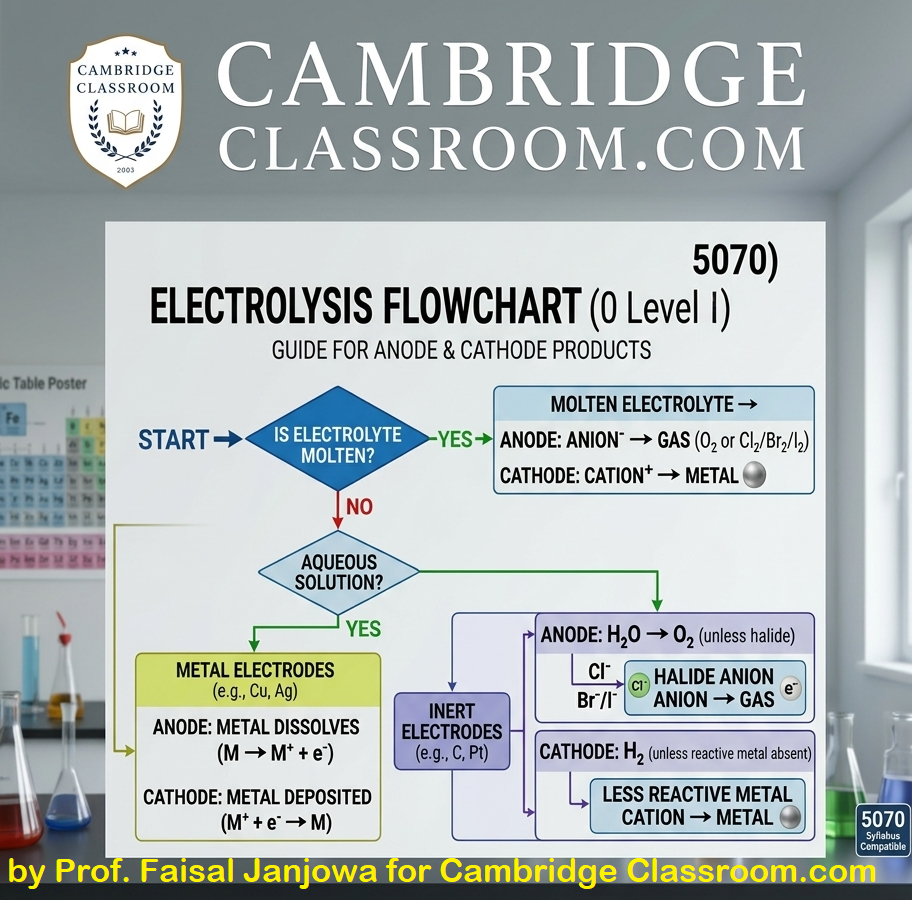
- Electrochemistry
This course breaks down these topics into simple, easy-to-understand lessons.
No more confusion. Just clarity.
📚 Master complex topics with ease:
👉 https://cambridgeclassroom.com/courses/stoichiometry-secrets-moles-made-simple/
👉 https://cambridgeclassroom.com/courses/organic-chemistry-alkanes-to-polymers/
✅ 3. Learn from Expert Instructors
Why waste time with outdated textbooks and ineffective methods?
In this course, you’ll learn from:
✅ Experienced Cambridge educators
✅ Examiner insights on how to score top marks
✅ Real-life applications to make Chemistry fun and engaging
✅ 4. Practice Smart with Past Papers
You can’t secure an A* without practicing past papers.
This course offers:
- Real exam-style questions
- Step-by-step solutions
- Marking schemes to understand how examiners award marks
📥 Download FREE past papers for practice:
👉 https://cambridgeclassroom.com/free-download-past-papers-of-o-level-chemistry-5070-guess-papers-solved-papers-in-pdf/
✅ 5. Interactive Learning for Better Results
Bored of traditional lectures?
This crash course includes:
- 🎥 Video lessons
- 📝 Quizzes and interactive activities
- 💡 Visual aids for better concept retention
You’ll stay engaged, motivated, and excited to learn.
✅ 6. Flexible, Study-From-Anywhere Format
No need to travel. No rigid schedules.
✅ Learn from the comfort of your home
✅ Access lessons anytime, anywhere
✅ Study at your own pace
Perfect for busy students juggling multiple subjects.
✅ 7. Boost Your Confidence for Exam Day
Confidence is key to exam success.
This course will help you:
- ✅ Identify your strengths and weaknesses
- ✅ Develop effective exam strategies
- ✅ Stay calm and focused under pressure
You’ll walk into the exam room knowing you’re fully prepared.
📚 What’s Included in the Chemistry Crash Course?
- Complete syllabus coverage for 5070 and 0620
- Topic-wise lessons with simplified explanations
- Practice worksheets and quizzes
- Past paper practice sessions with solutions
- Exam tips and strategies from Cambridge experts
🌟 Hear from Students Who Achieved A*
“I was struggling with Chemistry until I enrolled in the crash course. The lessons were so clear, and the past paper practice helped me feel confident. I got an A* in my exam!” — Ali, O Level Student
_”This course saved me! The concepts I found difficult became easy to understand. I highly recommend it to anyone aiming for top grades.” _— Sana, IGCSE Student
🚀 Take the First Step Toward Your A* Today!
Don’t wait until it’s too late.
Your A* in Chemistry 5070 and 0620 is within reach—IF you start now.
📌 Enroll in the Chemistry Crash Course Now:
👉 https://cambridgeclassroom.com/courses/o-level-chemistry-5070-and-igcse-chemistry-0620-crash-course-for-ix-grade-students/
📌 Download FREE Past Papers for Practice:
👉 https://cambridgeclassroom.com/free-download-past-papers-of-o-level-chemistry-5070-guess-papers-solved-papers-in-pdf/
📌 Explore More Courses for Complete Mastery:
👉 https://cambridgeclassroom.com/courses/crash-course-for-chemistry-5070-0620/
Your A* journey starts here. Don’t just aim for success—achieve it.
🌟 Visit https://cambridgeclassroom.com and unlock your Chemistry potential today! 🌟











![Fundamental Concepts & States of Matter • Atom: The smallest particle of an element that can exist, made of a nucleus (protons and neutrons) and electrons orbiting it. • Element: A pure substance consisting of only one type of atom, which cannot be broken down into simpler substances by chemical means. • Compound: A substance formed when two or more different elements are chemically bonded together in a fixed ratio. • Mixture: A substance containing two or more elements or compounds not chemically bonded together. Can be separated by physical means. • Molecule: A group of two or more atoms held together by chemical bonds. • Proton: A subatomic particle found in the nucleus with a relative mass of 1 and a charge of +1. • Neutron: A subatomic particle found in the nucleus with a relative mass of 1 and no charge (0). • Electron: A subatomic particle orbiting the nucleus with a negligible relative mass and a charge of -1. • Atomic Number (Z): The number of protons in the nucleus of an atom. Defines the element. • Mass Number (A): The total number of protons and neutrons in the nucleus of an atom. • Isotopes: Atoms of the same element (same atomic number) but with different mass numbers due to a different number of neutrons. • Relative Atomic Mass ($A_r$): The weighted average mass of an atom of an element compared to $1/12$th the mass of a carbon-12 atom. • Relative Molecular Mass ($M_r$): The sum of the relative atomic masses of all atoms in one molecule of a compound. • Relative Formula Mass ($M_r$): The sum of the relative atomic masses of all atoms in the formula unit of an ionic compound. • Mole: The amount of substance that contains $6.02 \times 10^{23}$ particles (Avogadro's number). • Molar Mass: The mass of one mole of a substance, expressed in g/mol. Numerically equal to $A_r$ or $M_r$. • Empirical Formula: The simplest whole number ratio of atoms of each element in a compound. • Molecular Formula: The actual number of atoms of each element in a molecule. • Solid: Particles are closely packed in a fixed, regular arrangement, vibrate about fixed positions. Definite shape and volume. • Liquid: Particles are closely packed but randomly arranged, can slide past each other. Definite volume, no definite shape. • Gas: Particles are far apart and arranged randomly, move rapidly and randomly. No definite shape or volume. • Melting Point: The specific temperature at which a solid changes into a liquid at a given pressure. • Boiling Point: The specific temperature at which a liquid changes into a gas (vaporizes) at a given pressure. • Sublimation: The direct change of state from solid to gas without passing through the liquid phase (e.g., solid $\text{CO}_2$). • Diffusion: The net movement of particles from a region of higher concentration to a region of lower concentration, due to random motion. • Osmosis: The net movement of water molecules across a partially permeable membrane from a region of higher water potential to a region of lower water potential. 2. Structure & Bonding • Ionic Bond: The electrostatic force of attraction between oppositely charged ions, formed by the transfer of electrons from a metal to a non-metal. • Covalent Bond: A strong electrostatic force of attraction between a shared pair of electrons and the nuclei of the bonded atoms, typically between two non-metals. • Metallic Bond: The electrostatic force of attraction between positive metal ions and delocalised electrons. • Ion: An atom or group of atoms that has gained or lost electrons, resulting in a net electrical charge. • Cation: A positively charged ion (lost electrons). • Anion: A negatively charged ion (gained electrons). • Octet Rule: Atoms tend to gain, lose, or share electrons in order to achieve a full outer electron shell, typically with eight electrons. • Giant Ionic Lattice: A regular, repeating 3D arrangement of oppositely charged ions, held together by strong electrostatic forces. • Simple Molecular Structure: Molecules held together by strong covalent bonds, but with weak intermolecular forces between molecules. • Giant Covalent Structure (Macromolecular): A large structure where all atoms are held together by strong covalent bonds in a continuous network (e.g., diamond, silicon dioxide). • Allotropes: Different structural forms of the same element in the same physical state (e.g., diamond and graphite are allotropes of carbon). • Electronegativity: The power of an atom to attract the electron pair in a covalent bond to itself. • Polar Covalent Bond: A covalent bond in which electrons are shared unequally due to a difference in electronegativity between the bonded atoms. • Hydrogen Bond: A strong type of intermolecular force that occurs between molecules containing hydrogen bonded to a highly electronegative atom (N, O, F). • Van der Waals' forces: Weak intermolecular forces of attraction between all molecules, arising from temporary dipoles. 3. Stoichiometry & Chemical Calculations • Stoichiometry: The study of quantitative relationships between reactants and products in chemical reactions. • Limiting Reactant: The reactant that is completely consumed in a chemical reaction, determining the maximum amount of product that can be formed. • Excess Reactant: The reactant present in a greater amount than required to react with the limiting reactant. • Yield: The amount of product obtained from a chemical reaction. • Theoretical Yield: The maximum amount of product that can be formed from a given amount of reactants, calculated using stoichiometry. • Actual Yield: The amount of product actually obtained from a chemical reaction, usually less than the theoretical yield. • Percentage Yield: $($Actual Yield $/$ Theoretical Yield$) \times 100\%$. • Concentration: The amount of solute dissolved in a given volume of solvent or solution. Often expressed in mol/dm$^3$ (molarity) or g/dm$^3$. • Solute: The substance that dissolves in a solvent to form a solution. • Solvent: The substance in which a solute dissolves to form a solution. • Solution: A homogeneous mixture formed when a solute dissolves in a solvent. 4. Chemical Reactions & Energetics • Chemical Reaction: A process that involves rearrangement of the atomic structure of substances, resulting in the formation of new substances. • Reactants: The starting substances in a chemical reaction. • Products: The substances formed as a result of a chemical reaction. • Word Equation: An equation that uses the names of the reactants and products. • Symbol Equation: An equation that uses chemical symbols and formulae to represent reactants and products, and is balanced. • Balancing Equation: Ensuring the number of atoms of each element is the same on both sides of a chemical equation. • Redox Reaction: A reaction involving both reduction and oxidation. • Oxidation: Loss of electrons, gain of oxygen, or loss of hydrogen. Increase in oxidation state. • Reduction: Gain of electrons, loss of oxygen, or gain of hydrogen. Decrease in oxidation state. • Oxidising Agent: A substance that causes oxidation by accepting electrons (and is itself reduced). • Reducing Agent: A substance that causes reduction by donating electrons (and is itself oxidised). • Exothermic Reaction: A reaction that releases energy to the surroundings, usually as heat, causing the temperature of the surroundings to rise. $\Delta H$ is negative. • Endothermic Reaction: A reaction that absorbs energy from the surroundings, usually as heat, causing the temperature of the surroundings to fall. $\Delta H$ is positive. • Activation Energy ($E_a$): The minimum amount of energy required for reactants to collide effectively and initiate a chemical reaction. • Catalyst: A substance that increases the rate of a chemical reaction without being chemically changed itself, by providing an alternative reaction pathway with a lower activation energy. • Enthalpy Change ($\Delta H$): The heat energy change measured at constant pressure for a reaction. • Standard Enthalpy of Formation ($\Delta H_f^\circ$): The enthalpy change when one mole of a compound is formed from its constituent elements in their standard states under standard conditions. • Standard Enthalpy of Combustion ($\Delta H_c^\circ$): The enthalpy change when one mole of a substance is completely combusted in oxygen under standard conditions. • Hess's Law: The total enthalpy change for a reaction is independent of the route taken, provided the initial and final conditions are the same. 5. Rates of Reaction & Equilibrium • Rate of Reaction: The change in concentration of a reactant or product per unit time. • Collision Theory: For a reaction to occur, reactant particles must collide with sufficient energy (activation energy) and correct orientation. • Factors Affecting Rate: Concentration, pressure (for gases), surface area, temperature, and presence of a catalyst. • Reversible Reaction: A reaction where products can react to reform the original reactants, indicated by $\rightleftharpoons$. • Chemical Equilibrium: A state in a reversible reaction where the rate of the forward reaction is equal to the rate of the reverse reaction, and the concentrations of reactants and products remain constant. • Le Chatelier's Principle: If a change in conditions (temperature, pressure, concentration) is applied to a system at equilibrium, the system will shift in a direction that counteracts the change. 6. Acids, Bases & Salts • Acid: A substance that produces hydrogen ions ($H^+$) when dissolved in water (Arrhenius definition) or a proton donor (Brønsted-Lowry definition). • Base: A substance that produces hydroxide ions ($OH^-$) when dissolved in water (Arrhenius definition) or a proton acceptor (Brønsted-Lowry definition). • Alkali: A soluble base that dissolves in water to produce hydroxide ions ($OH^-$). • Salt: A compound formed when the hydrogen ion of an acid is replaced by a metal ion or an ammonium ion. • Neutralisation: The reaction between an acid and a base (or alkali) to form a salt and water. $H^+(aq) + OH^-(aq) \rightarrow H_2O(l)$. • pH: A measure of the acidity or alkalinity of a solution, defined as $-\log_{10}[H^+]$. Scale from 0 to 14. • Strong Acid: An acid that fully dissociates (ionizes) in water (e.g., HCl, $H_2SO_4$). • Weak Acid: An acid that partially dissociates (ionizes) in water (e.g., $CH_3COOH$). • Strong Base: A base that fully dissociates in water (e.g., NaOH, KOH). • Weak Base: A base that partially dissociates in water (e.g., $NH_3$). • Amphoteric: A substance that can act as both an acid and a base (e.g., aluminium oxide, water). • Titration: A quantitative chemical analysis method used to determine the unknown concentration of a reactant using a known concentration of another reactant. • Indicator: A substance that changes colour over a specific pH range, used to detect the endpoint of a titration. 7. Electrochemistry • Electrolysis: The decomposition of an ionic compound using electrical energy. Requires molten or aqueous electrolyte. • Electrolyte: An ionic compound (molten or dissolved in a solvent) that conducts electricity due to the movement of ions. • Electrodes: Conductors (usually metal or graphite) through which electricity enters and leaves the electrolyte. • Anode: The positive electrode, where oxidation occurs (anions are attracted). • Cathode: The negative electrode, where reduction occurs (cations are attracted). • Faraday's Laws of Electrolysis: Relate the amount of substance produced at an electrode to the quantity of electricity passed through the electrolyte. • Galvanic (Voltaic) Cell: An electrochemical cell that generates electrical energy from spontaneous redox reactions. • Standard Electrode Potential ($E^\circ$): The potential difference of a half-cell compared to a standard hydrogen electrode under standard conditions (1 M concentration, 1 atm pressure for gases, 298 K). • Electrochemical Series: A list of elements arranged in order of their standard electrode potentials, indicating their relative reactivity as oxidising or reducing agents. 8. The Periodic Table • Periodic Table: An arrangement of elements in order of increasing atomic number, showing periodic trends in properties. • Group: A vertical column in the periodic table, containing elements with the same number of valence electrons and similar chemical properties. • Period: A horizontal row in the periodic table, containing elements with the same number of electron shells. • Valence Electrons: Electrons in the outermost shell of an atom, involved in chemical bonding. • Alkali Metals (Group 1): Highly reactive metals, readily lose one electron to form $+1$ ions. React vigorously with water. • Alkaline Earth Metals (Group 2): Reactive metals, readily lose two electrons to form $+2$ ions. • Halogens (Group 17/7): Highly reactive non-metals, readily gain one electron to form $-1$ ions. Exist as diatomic molecules. • Noble Gases (Group 18/0): Unreactive elements with a full outer electron shell, existing as monatomic gases. • Transition Metals: Elements in the d-block of the periodic table, characterised by variable oxidation states, coloured compounds, and catalytic activity. • Metallic Character: Tendency of an element to lose electrons and form positive ions. Increases down a group, decreases across a period. • Non-metallic Character: Tendency of an element to gain electrons and form negative ions. Decreases down a group, increases across a period. • Ionisation Energy: The energy required to remove one electron from each atom in one mole of gaseous atoms to form one mole of gaseous $1+$ ions. • Electron Affinity: The energy change when one mole of electrons is added to one mole of gaseous atoms to form one mole of gaseous $1-$ ions. 9. Organic Chemistry • Organic Chemistry: The study of carbon compounds, excluding carbonates, carbides, and oxides of carbon. • Hydrocarbon: A compound containing only carbon and hydrogen atoms. • Saturated Hydrocarbon: A hydrocarbon containing only single carbon-carbon bonds (e.g., alkanes). • Unsaturated Hydrocarbon: A hydrocarbon containing one or more carbon-carbon double or triple bonds (e.g., alkenes, alkynes). • Homologous Series: A series of organic compounds with the same general formula, similar chemical properties, and showing a gradual change in physical properties. • Functional Group: A specific group of atoms within a molecule that is responsible for the characteristic chemical reactions of that molecule. • Alkane: Saturated hydrocarbons with the general formula $C_nH_{2n+2}$. Contain only single bonds. • Alkene: Unsaturated hydrocarbons with the general formula $C_nH_{2n}$. Contain at least one carbon-carbon double bond. • Alkyne: Unsaturated hydrocarbons with the general formula $C_nH_{2n-2}$. Contain at least one carbon-carbon triple bond. • Alcohol: Organic compounds containing the hydroxyl functional group ($-OH$). General formula $C_nH_{2n+1}OH$. • Carboxylic Acid: Organic compounds containing the carboxyl functional group ($-COOH$). • Ester: Organic compounds formed from the reaction of a carboxylic acid and an alcohol, containing the ester linkage ($-COO-$). • Isomers: Compounds with the same molecular formula but different structural formulae. • Structural Isomers: Isomers that differ in the arrangement of their atoms or bonds. • Addition Reaction: A reaction where an unsaturated molecule adds across a double or triple bond, forming a single product. • Substitution Reaction: A reaction where an atom or group of atoms in a molecule is replaced by another atom or group of atoms. • Polymerisation: The process of joining many small monomer molecules together to form a large polymer molecule. • Monomer: A small molecule that can be joined together to form a polymer. • Polymer: A large molecule (macromolecule) formed from many repeating monomer units. • Addition Polymerisation: Polymerisation where monomers add to one another in such a way that the polymer contains all the atoms of the monomer. Usually involves unsaturated monomers. • Condensation Polymerisation: Polymerisation where monomers join together with the elimination of a small molecule (e.g., water). • Cracking: The process of breaking down long-chain hydrocarbons into shorter, more useful hydrocarbons using heat and/or a catalyst. • Fermentation: The anaerobic respiration of yeast, converting glucose into ethanol and carbon dioxide. 10. Analytical Chemistry • Qualitative Analysis: The identification of the components of a sample. • Quantitative Analysis: The determination of the amount or concentration of a component in a sample. • Chromatography: A separation technique based on differential partitioning between a stationary phase and a mobile phase. • Retention Factor ($R_f$): In paper/thin-layer chromatography, the ratio of the distance travelled by the spot to the distance travelled by the solvent front. • Spectroscopy: The study of the interaction of electromagnetic radiation with matter. • Infrared (IR) Spectroscopy: Used to identify functional groups in organic molecules based on their absorption of IR radiation. • Mass Spectrometry: Used to determine the relative molecular mass of a compound and its fragmentation pattern to deduce structure. • Flame Test: A qualitative test for the presence of certain metal ions, which produce characteristic colours when heated in a flame.](https://i0.wp.com/cambridgeclassroom.com/wp-content/uploads/2024/03/White-And-Purple-Modern-Online-Graphic-Design-Courses-Instagram-Post-4.png?resize=150%2C150&ssl=1)